Crops associated with shrubs in the Sahel
How agroforestry enhances food sovereignty and economic stability
As we have seen, agroforestry increases yields through various ecosystem services, such as improved soil fertility and access to water. It also increases resilience to the adverse effects of climate change, such as irregular rainfall or periods of drought, enabling farmers to harvest even in dry years. Particularly on land threatened by desertification, preventing soil erosion is essential to maintaining yields. All of this has a direct impact on harvests.
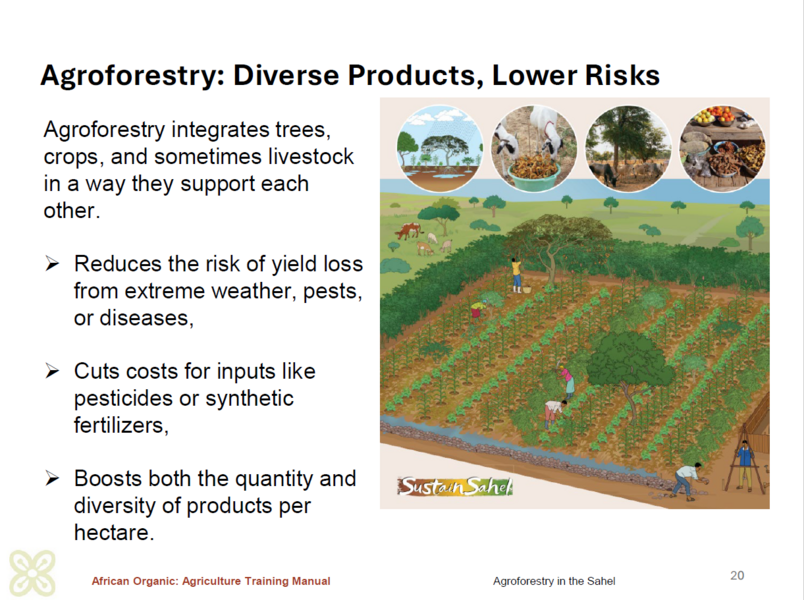
In addition, agroforestry is based on integrating several plant species and livestock in a complementary and beneficial way.
This diversification leads to a rich source of varied food, as well as products for sale. For example, integrating multipurpose local trees, such as shea (Vitellaria paradoxa), moringa (Moringa oleifera), baobab (Adansonia digitata), Piliostigma, or coconut (Cocos nucifera), provides ecosystem services while generating marketable products.

Similarly, combining local fodder from trees or shrubs (e.g., Piliostigma) with livestock farming ensures high-quality feed for livestock, which translates into access to high-quality meat.

This diversity also offers economic stability, otherwise known as resiliencebecause even if one crop species, such as sorghum, is attacked by disease, another species from a different botanical family can continue to produce, being naturally resistant to that disease.
Finally, integrating several agricultural species (trees, crops, forage plants, etc.) on the same plot of land results in significantly higher overall productivity per hectare than a traditional monoculture system.
In addition, this variety of plant species makes it possible to spread food, fodder, and economic production throughout the year, while balancing the workload. For example, fodder produced by trees and shrubs remains available during the dry season to feed animals; shea fruits ripen during the rainy season, while peanuts are harvested afterwards. This provides farmers with a continuous supply of resources and a work schedule that is less concentrated in a specific period.

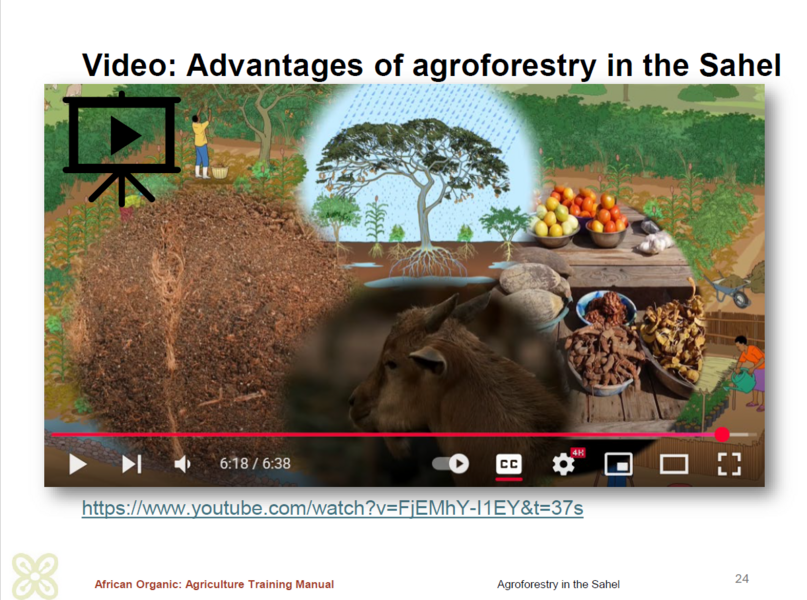
Here is a summary of the main advantages of agroforestry in the Sahel region, as presented in the video "Advantages of agroforestry in the Sahel." https://youtu.be/FjEMhY-I1EY?feature=shared
Key recommendations for growing shrubs and trees in fields:
- Encourage the growth of trees and shrubs and increase their density (for example, a density of 1,000 to 2,000 trees per hectare of Piliostigma is recommended).
- Objective: improve soil structure and fertility, promote water infiltration, suppress weeds, encourage beneficial soil organisms and retention, all leading to higher yields.
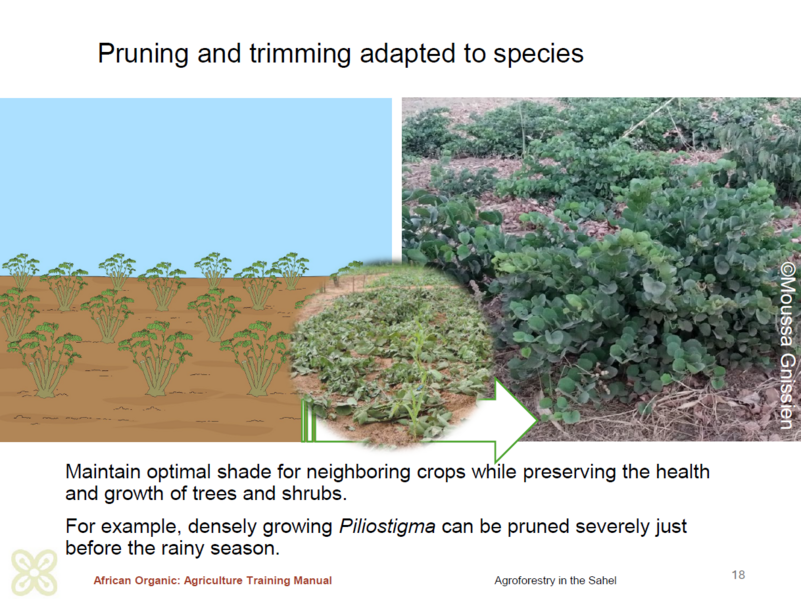
- Pruning (trimming and pollarding) of shrubs and trees, plus mulching of plant residues, tailored to each species and objective. For example, Faidherbia does not shade crops because it loses its leaves during the rainy season; densely planted Piliostigma should be pruned before the rains to manage shade during cultivation season.
- Objective: well-managed shade allows crops to grow close to shrubs and trees, promoting countless beneficial interactions such as improved soil health and easier biomass harvesting.
- Integrate shrub or tree species (e.g., Guiera or Faidherbia, Shea (Vitellaria paradoxa), and Néré (Parkia biglobosa)) that have the ability to redistribute water, i.e., transport water from deep aquifers to the soil surface.
- Objective: to make moisture accessible to crops with shallower roots.
- In shallow soils, plant Piliostigma or Guiera at a density of 1,000 to 2,000 plants/ha.
- Objective: to improve permeability and reduce erosion.
Reflection on the benefits of trees in fields
You can show this video to farmers during a workshop session or share it via communication platforms or messaging channels. After the presentation, you can facilitate a discussion about the video and how it relates to the farmers' experiences. To encourage discussion, you can ask the following questions:
- What observations have you made about trees and shrubs in or around fields?
- What are the most obvious benefits?
- To what extent are the benefits relevant to agricultural production and income?
The video is available in five local languages on the SustainSahel YouTube channel.
https://www.youtube.com/watch?v=FjEMhY-I1EY&t=37s
In addition, you can download a brochure containing a poster illustrating the agroforestry system explained in the video as well as best practices: download it via the link, print it, and share it with farmers.
 tap and then scroll down to the Add to Home Screen command.