Crops associated with shrubs in the Sahel
Why do soils improve when shrubs grow in fields?
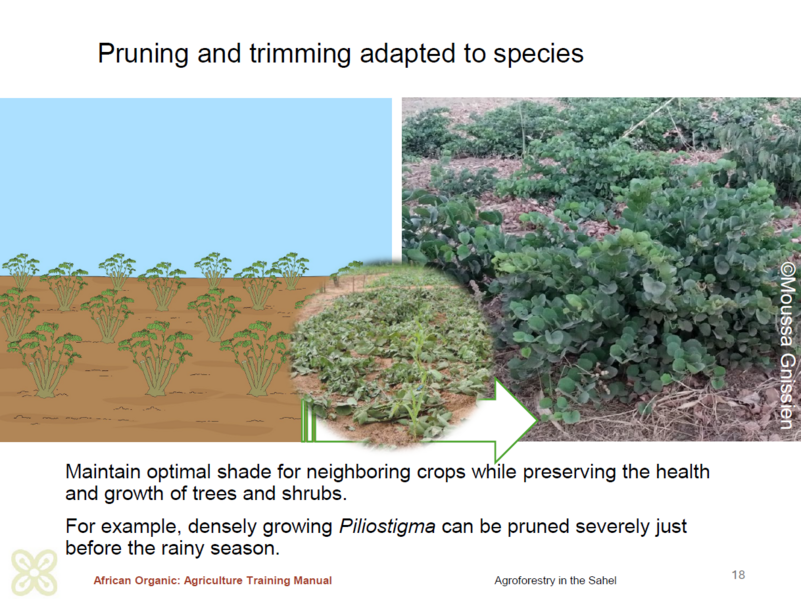
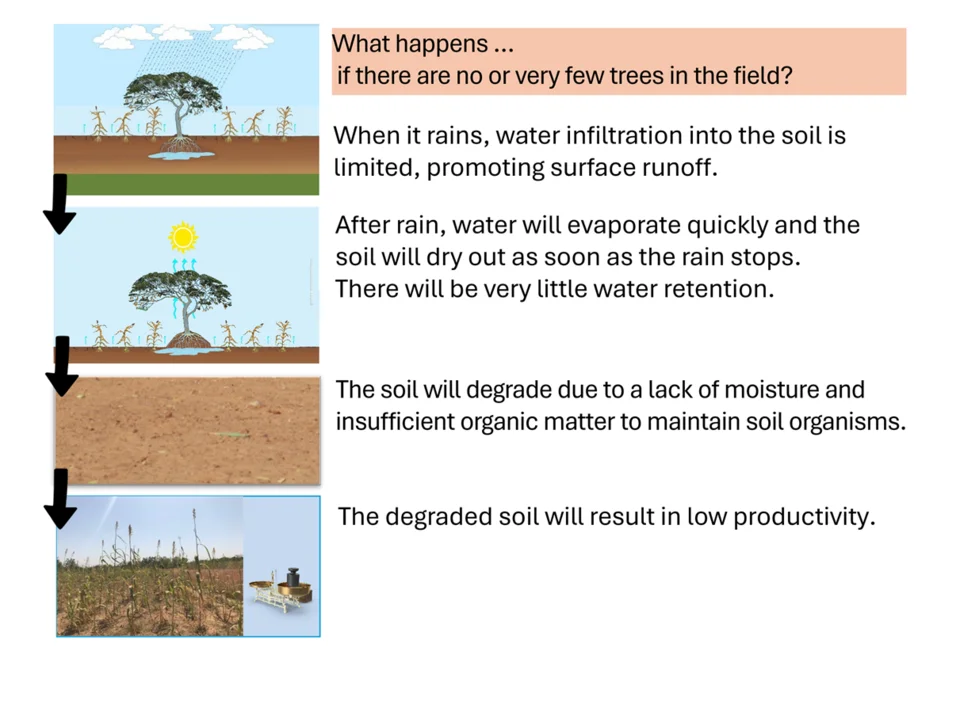
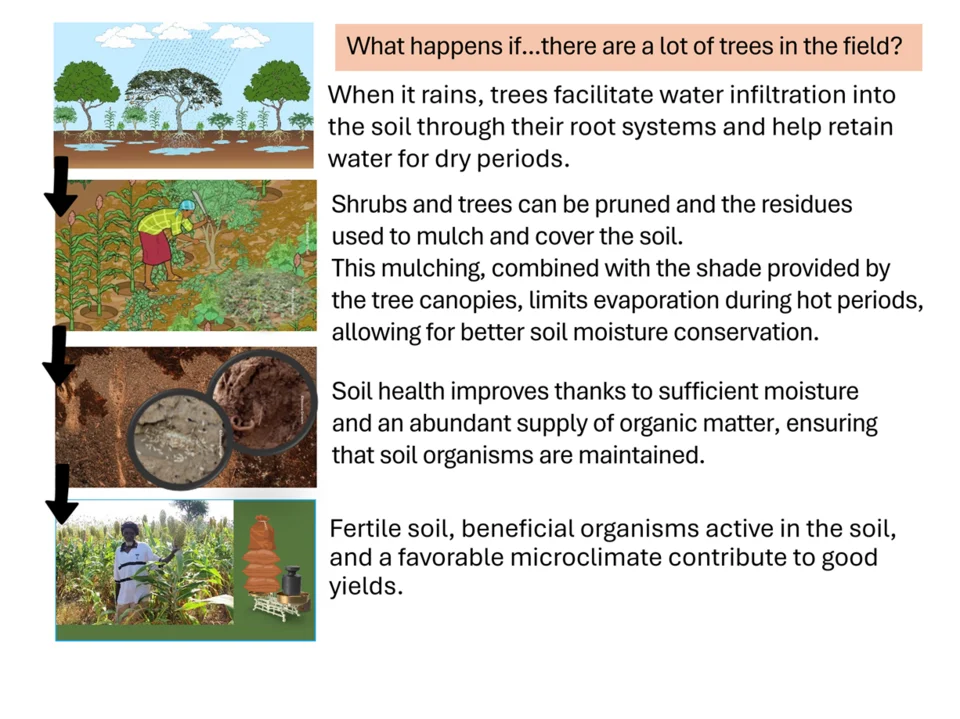
The landscape often lacks vegetation cover during the dry season. This leads to erosion and drying out of the soil. Local resilient and beneficial shrubs can provide better soil cover and greater root density, which holds the soil in place and shades it with their foliage, thus providing a favorable environment for soil organisms. Shrubs can be pruned before the rainy season to regulate shade for crops, enabling higher planting densities than trees. The pruned residues are then applied directly as mulch to enrich the soil, simple and effective method known as the "cut-and-drop" technique.
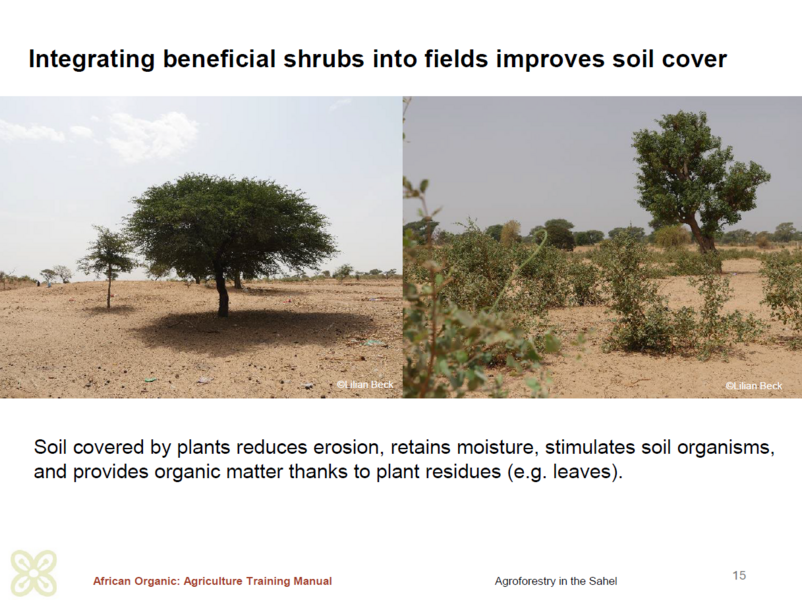
It is not only the biomass of trees and shrubs, used as mulch or incorporated into the soil, that has a positive effect: the mere presence of trees and shrubs and their root systems in fields can also bring promising benefits.
For example: The yield of sorghum increases significantly in the proximity of Piliostigma shrubs. (Gnissien et al. 2023). Another example is that the proximity of Guiera, coppiced at the beginning of the season, increases the weight of millet grains, which means that quality increases (Hane et al. 2025) .

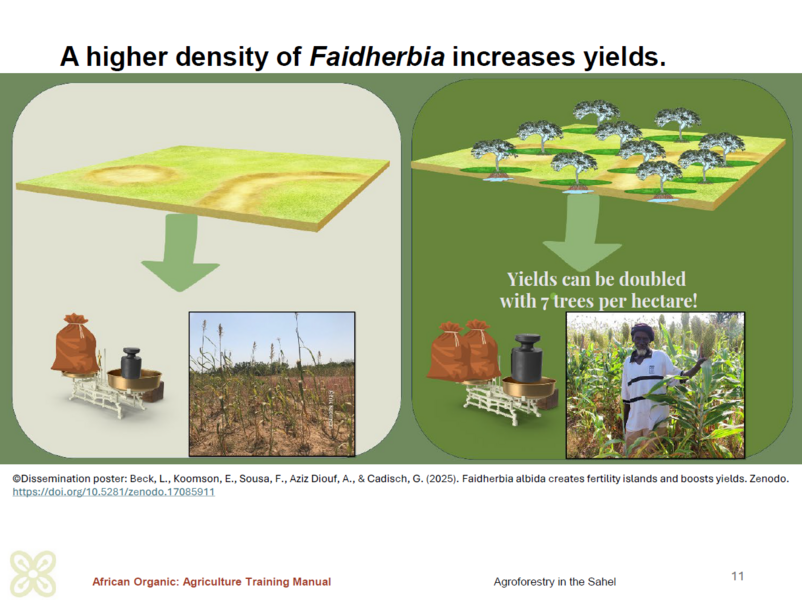
When Faidherbia is present in the field, the soil contains much more nutrients and organic matter (+62% in the top 10 cm of soil). This helps millet grow better and produce higher yields (Siegwart et al. 2022) . But that's not all. Faidherbia is truly an exceptional tree: it keeps its leaves during the dry season but loses them during the rainy season, when crops are growing. This means it does not compete with them for water or light, and helps them to grow better (Diongue et al., 2023). The fall of litter at the beginning of the rainy season, which naturally covers the soil with mulch just in time to contribute to crop growth. This litter naturally covers the soil in mulch, which contributes to crop growth.
In addition, the proximity of Faidherbia albida to within 10 m leads to synergies between several ecosystem services, such as weed control (Striga) (Agbohessou et al. 2025) .
According to a simulation, combining Faidherbia with cereals such as millet and sorghum improved yields at all sites studied, except in Saria, where rainfall is higher. It was the drier regions that benefited most from the presence of trees. A simulation showed that yields increase with the number of associated trees (Koomson et al. 2025).
Trees and shrubs act as microhabitat refuges for soil organisms. Their shade, mulch, and stable microclimate create ideal conditions for beneficial soil life such as earthworms, fungi, and beneficial insects to thrive. Mulch further protects and feeds these organisms, making such areas biodiversity hotspots compared to open fields. For instance the density of soil macrofauna can increase significantly near Piliostigma (Gnissien et al. 2025).
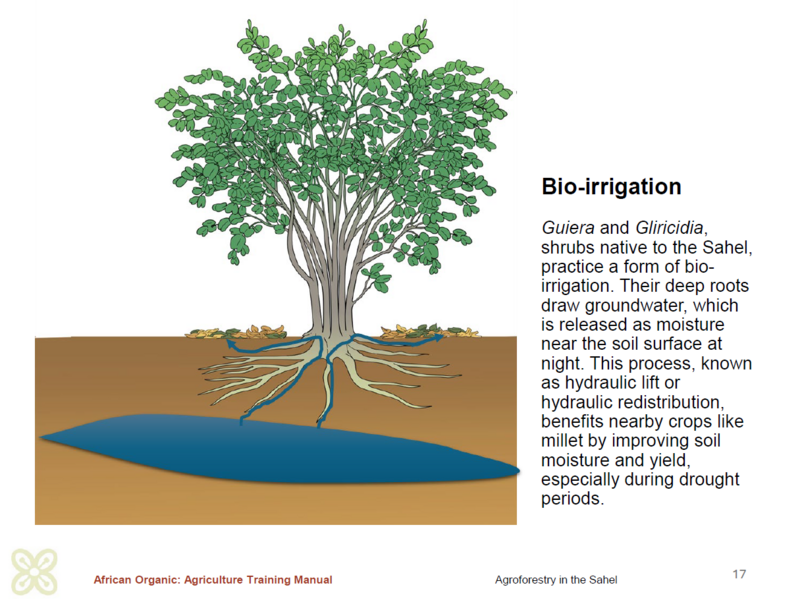
In addition, Guiera naturally irrigates the soil at night. Its deep roots draw water from the subsoil, which it releases near the surface. Neighboring crops benefit greatly from this, which can increase their biomass. Bio-irrigation enhances soil respiration, plant growth, microbial life and resilience to drought.
Conducting field trials, researchers observed that a density of between 1,000 and 2,000 Piliostigma plants per hectare is recommended in order to improve soil permeability and water retention capacity (Gnissien et al. 2023). The best results were achieved with cowpeas grown in dense Piliostigma fields (2,000 plants per hectare), particularly when combined with cultivation in zai pits (Gnissien et al., 2023).
Key recommendations for growing shrubs and trees in fields:
- Encourage the growth of trees and shrubs and increase their density (for example, a density of 1,000 to 2,000 trees per hectare of Piliostigma is recommended).
- Objective: improve soil structure and fertility, promote water infiltration, suppress weeds, encourage beneficial soil organisms and retention, all leading to higher yields.
- Pruning (trimming and pollarding) of shrubs and trees, plus mulching of plant residues, tailored to each species and objective. For example, Faidherbia does not shade crops because it loses its leaves during the rainy season; densely planted Piliostigma should be pruned before the rains to manage shade during cultivation season.
- Objective: well-managed shade allows crops to grow close to shrubs and trees, promoting countless beneficial interactions such as improved soil health and easier biomass harvesting.
- Integrate shrub or tree species (e.g., Guiera or Faidherbia, Shea (Vitellaria paradoxa), and Néré (Parkia biglobosa)) that have the ability to redistribute water, i.e., transport water from deep aquifers to the soil surface.
- Objective: to make moisture accessible to crops with shallower roots.
- In shallow soils, plant Piliostigma or Guiera at a density of 1,000 to 2,000 plants/ha.
- Objective: to improve permeability and reduce erosion.
Talk to farmers about the species of shrubs they would like to incorporate into their fields and the benefits they know or have already observed (e.g., soil improvement, shade, fodder, erosion protection).
You can use the PowerPoint slides in our manual to discuss beneficial effects such as bio-irrigation and soil protection with farmers.
 tap and then scroll down to the Add to Home Screen command.