Case study: Agroforestry and cotton in the Sahel
Even sun-loving crops such as cotton are affected by climate change, which is leading to increased heat and irregular rainfall, including periods of drought.
In turn, cotton can benefit from the integration of shrubs and trees, which create a favorable microclimate by maintaining humidity, providing a cooling effect and nutrients, promoting water infiltration and hydraulic pumping, and improving soil health
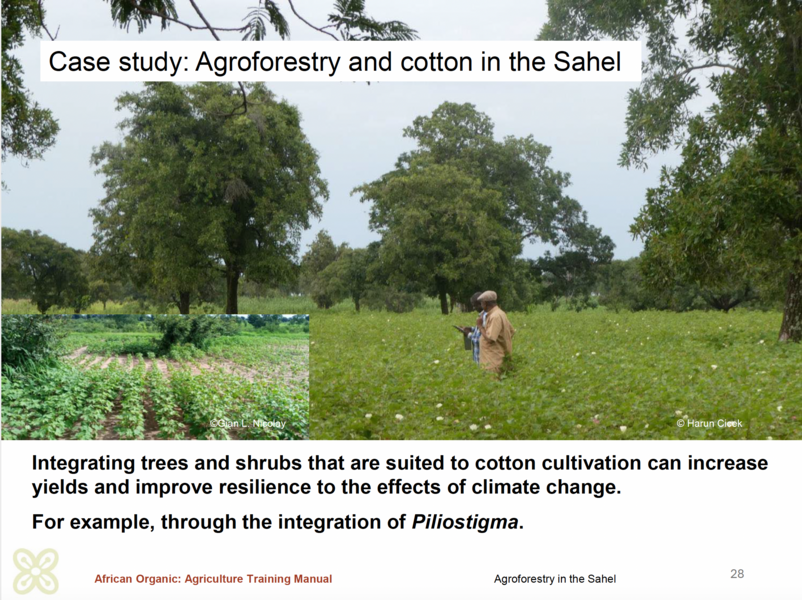
Research has shown that cotton yields can increase when shrubs and trees are integrated, provided they are properly managed and do not provide excessive shade. An effective approach is to prune these plants before the growing season, which also provides mulch from the leaves. It is also important to use species with low foliage density. Ideal trees are those that lose their leaves during the rainy season, such as Faidherbia albida. (Akodéwou et al. 2024).
Studies have shown that growing cotton and sorghum in corridors with Gliricidia results in higher yields (Doumbia et al. 2020a) . In addition, applying mulch made from pruned plant residues, such as leaves, to cotton fields at the beginning of the rainy season can enrich the soil's organic matter and, as a result, improve yields.
A beneficial strategy could be to grow cotton and Gliricidia or Piliostigma in east-west oriented alleys to ensure sufficient sunlight, spaced approximately 4 to 6 meters apart. This arrangement would ensure proximity to the shrubs while allowing sufficient sunlight for the cotton.
Alley cropping also provides space for mechanization between rows of shrubs if the distance between the rows of shrubs is suitable for the tools used for mechanization.
If you would like to learn more about how to propagate trees in agricultural fields, you can consult our guides on the propagation of trees and shrubs.
https://zenodo.org/records/17453240
Reflection on the benefits of trees in fields
Share this concrete example with farmers and encourage discussion. https://youtu.be/lPM6dKxnwyo?si=xn24eftqKjow7Cor
The following questions may be useful:
- Do you know anyone who has an agroforestry operation?
- What are the farm's most striking features at first glance?
- What trees and shrubs have been planted?
- Are they arranged in a particular way?
- What other measures, besides planting trees and shrubs, are being implemented to protect the soil and promote crop growth?
- What are the challenges involved in creating such a garden? How have these challenges been overcome?
Discuss the questions and try to clarify how they perceive the transformation of degraded soil into a green field during the dry season thanks to agroforestry. Together, draw conclusions from the discussion on the benefits for farmers and the challenges involved in setting up a similar farm.
 tap and then scroll down to the Add to Home Screen command.