The importance of adding organic matter and promoting soil life
To what extent can adding organic matter increase yields?
Researchers from various scientific institutions have joined forces in the SustainSahel project to study this question from several angles in three countries in the Sahel region: Mali, Burkina Faso, and Senegal. Combining complementary approaches, they conducted participatory field trials with local communities, carried out laboratory analyses, set up field experiments, performed simulations, and conducted in-depth soil studies. This interdisciplinary collaboration has led to a better understanding of the mechanisms at play.
Let's examine some key findings:
Yields and soil health are closely linked. So, to begin with, we must ask ourselves: What would happen if we did nothing to improve soil health and fertility?
To answer this question, our scientists explored different scenarios using simulation tools.
What happens if we do not apply organic matter to the soil after a period of 20 years under increasingly difficult future climate conditions, such as droughts and floods?
The simulation results indicated that the soil will degrade, meaning it will lose its ability to properly nourish crops (Koomson et al. 2025).
What will happen if we only apply mineral fertilizers?
The soil will degrade even further (Koomson et al. 2025). Another long-term study in the Sahel may provide an explanation: degraded soil does not respond well to chemical fertilizers. What's more, these fertilizers, especially when used alone, can acidify the soil and harm its biological processes (Adams et al. 2016).
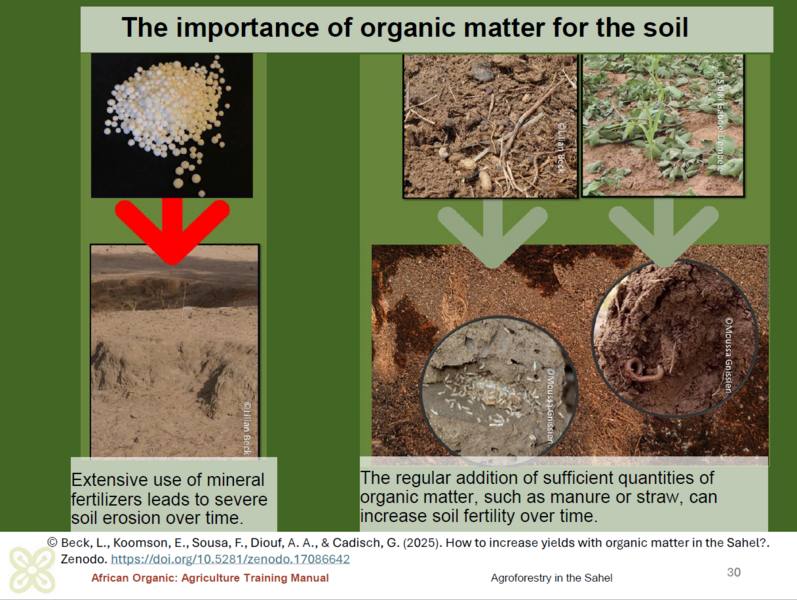
Above all, chemical fertilizers cannot replace organic matter, which is essential for soil structure and microbial life. In other words, mineral fertilizers do not promote soil health and fertility, improve soil structure, accumulate organic matter, or support a diverse and active soil community. For this, it is essential to add organic matter.
How to add organic matter effectively, will be explored in the following chapters.
 tap and then scroll down to the Add to Home Screen command.