Mulching, composting, agricultural nutrient cycles (manure)
What happens if we apply organic matter, such as plant residues or manure?
Applying plant residues or manure will stabilize or increase soil fertility. For example, a simulation using real data from agronomic trials in Senegal showed that applying 2.5 tons of Guiera residues per hectare over a period of 6 years increases yields compared to no organic matter. If 2.5 tons of manure is used, yields can be even higher, and if 5 tons of manure is applied, they can be 8 times higher than if no organic matter is added (Koomson et al. 2025) .
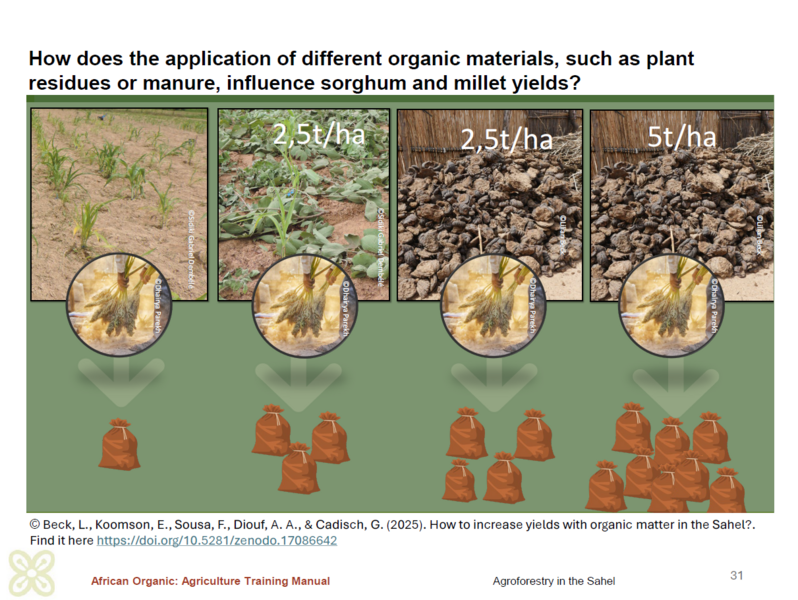
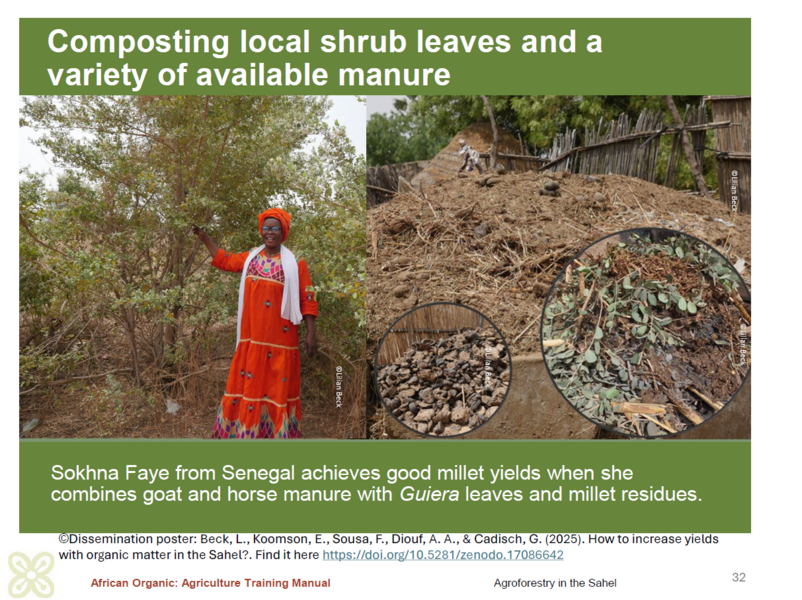
To assess the feasibility of using locally available organic matter under real farming conditions, the team conducted field studies in collaboration with farmers. The farmers used the resources available on their farms, such as local shrubs and various types of manure, millet residues, and the team then evaluated the results, noting an overall improvement in crop yields. For millet, a treatment combining horse and small ruminant manure (2.5 t/ha) and Guiera senegalensis residues (2.5 t/ha) yielded the best results, with a 46.1% increase compared to the control (Founoune-Mboup et al. 2025) . Furthermore, by using readily available resources such as shrub leaves and manure, the practice becomes inexpensive.
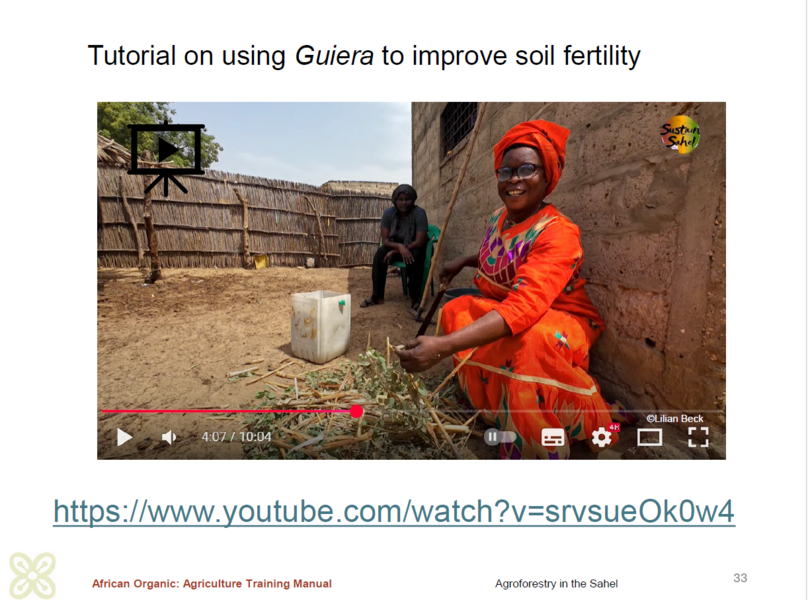
Find out how to make highly fertile compost from local shrubs by watching our video for practical tips and techniques! https://youtu.be/srvsueOk0w4?si=fx2CY3pYW-G6EFsB
Key recommendations:
- Prioritize organic matter inputs and use mineral fertilizers only in reduced doses and in combination with organic soil amendments such as mulch, compost, and manure.
- Objective: reduce costs, regenerate soil fertility and health, and improve nutrient use efficiency.
- Mix shrub/tree residues with locally available biomass, such as manure and crop residues.
- Objective: to obtain balanced compost for successful production and rich compost.
- Adopt the practice of burying compost at a shallow depth, mixing mulch into the soil instead of leaving it on the surface.
- Objective: to protect the compost from drying out or wind erosion, in order to improve soil structure and stimulate soil organisms.
- Compost species that are high in nitrogen and low in lignin, such as neem (Azadirachta indica).
- Objective: rapid release of nutrients.
- Spread livestock manure on fields, for example by rotating livestock locations (pens) in fields during the dry season or by composting manure combined with local tree/shrub/crop residues for spreading on fields.
- Objective: to stimulate plant growth relatively quickly and long-term soil fertility.
Discuss influence and importance of organic amendments
You can use this poster, produced in collaboration with scientists and farmers, to discuss with farmers the influence and importance of organic amendments on crop yields.
https://zenodo.org/records/17390264
You can watch this video on the use of Guiera as mulch and compost with farmers.
https://youtu.be/srvsueOk0w4?si=fx2CY3pYW-G6EFsB
Then you can ask farmers the following question:
- What organic resources are available in your region or on your farms that you can use to improve the organic matter in your soils?
- For example: manure, compost, plant residues, local shrubs (such as Guiera senegalensis), etc.
- Do you use one or more of these resources? Which ones?
- Which ones are most readily available or easy to access?
- Which ones are rarely or never used? Why?
- Have you noticed any positive effects on your soil after application?
- What composting methods are you familiar with or already use?
 tap and then scroll down to the Add to Home Screen command.