How to mulch trees and shrub leaves?
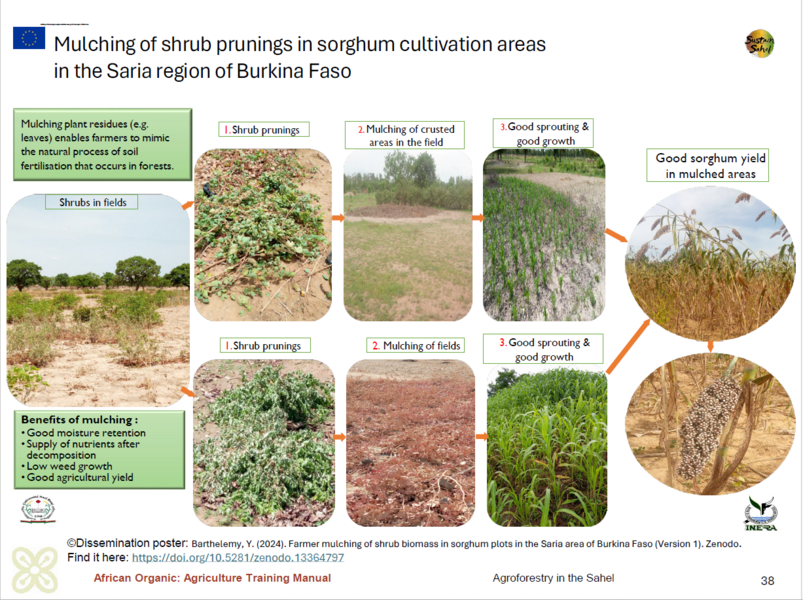
Objective of mulching:
To improve soil fertility, conserve moisture, protect seedlings, and increase nutrient supply through the combined use of mulch and manure or compost.
Steps to follow:
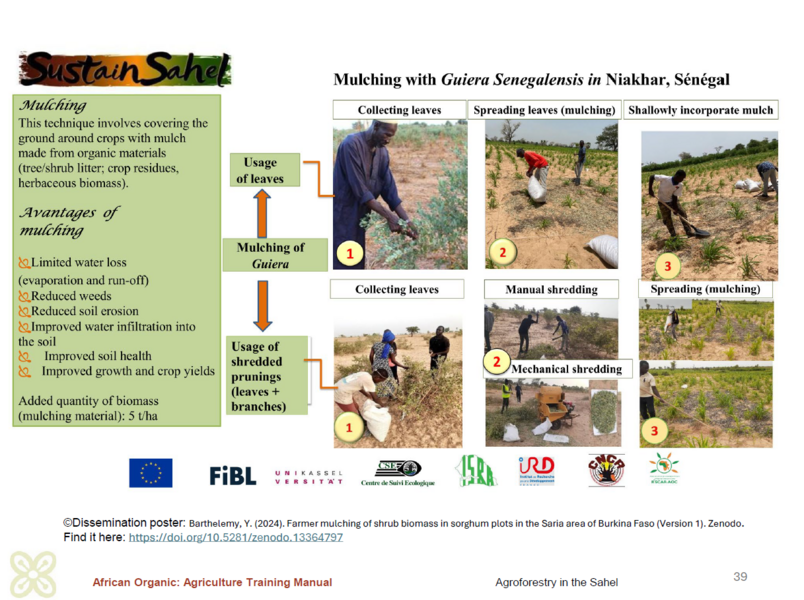
1. Collect mulch (biomass)
- Prune trees and shrubs in your field and scatter the pruning residues
- Collect pruning residues from local trees and shrubs—they are rich in nutrients
- Collect leaves, branches, dry grass, and other plant debris from the bush or from unprotected trees.
- Practice selective pruning to preserve trees and shrubs and support natural regeneration
- Do not cut the entire shrub, only a few branches per plant, so that they can regenerate well and produce more leaves next year.
2. Prepare mulch
- Mix different plant species to create a diverse mulch with a more balanced nutrient supply.
- Allow the plant material to dry slightly if the biomass is too wet or green.
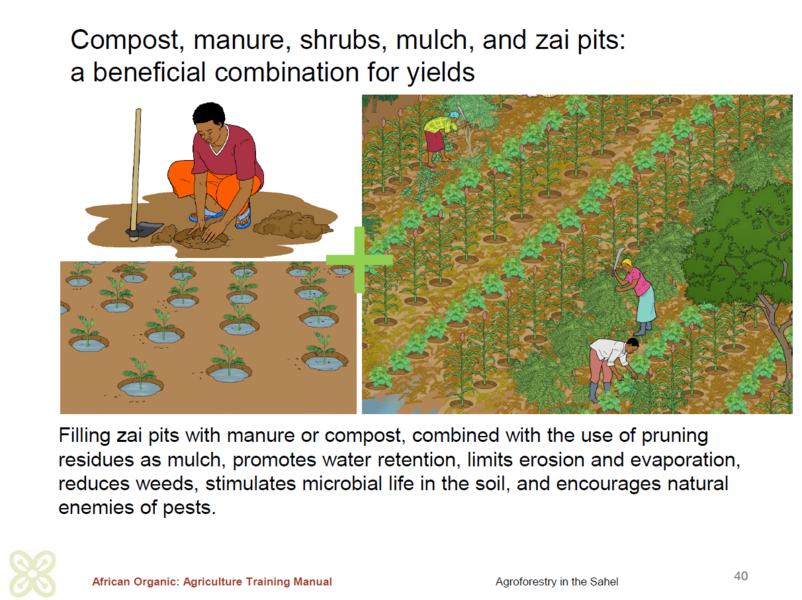
3. To improve soil fertility: Combine mulch and manure/compost
- Before applying the mulch, spread a thin layer of well-rotted manure or compost on the soil.
Then cover the manure or compost with mulch.
This mixture improves:
- The nutrient content of the soil,
- the biological activity of the soil,
- water retention, and
- the natural decomposition of the mulch.
4. Apply mulch to the field
- Apply mulch 1 to 2 weeks before sowing or planting crops.
- Cover the entire field, or prioritize the most degraded areas.
Protect the mulch from the wind.
To prevent the mulch from blowing away:
- Place thick branches on top
- or add a thin layer of soil to hold it in place.
5. Before sowing or planting
- Gently spread the mulch away from the planting hole.
- Place the seed, then lightly replace the mulch around it to retain moisture without covering the seed.
6. Protect the soil during the dry season
- Cover the soil with light mulch, crop residues, and/or any other organic matter available.
This helps to:
- Preserve moisture in the soil,
- limit wind erosion,
- protect microorganisms and soil structure, and
- reduce the formation of a hard crust on the surface.
Tips
- Do not use diseased or toxic plants as mulch.
- Reapply mulch if it has decomposed too much or been blown away by the wind.
The combination of watering, composting, and mulching is a synergistic agroecological strategy:
- Compost enriches the soil with organic matter and nutrients (nitrogen, phosphorus, potassium) over a prolonged period, improves soil texture and water retention capacity, and stimulates microbial biodiversity, which is essential for the release of nutrients for plants.
- Mulching, placed on the surface, limits evaporation, stabilizes soil temperature (particularly by mitigating excess heat), and promotes the activity of living organisms that gradually decompose organic matter.
- Watering allows roots to absorb dissolved nutrients—which are transported within the plant via water—while promoting the functioning of soil microorganisms.
By combining these three practices:
- The soil remains moist and well aerated, which maximizes the solubilization of nutrients and their availability to plants.
- Microorganisms in the soil have both an optimal habitat (moisture, nutrients) and a substrate in which to develop and make nutrients available to plants in a form that can be absorbed by the roots.
- The temperature remains stable, avoiding thermal stress that reduces root absorption.
In summary: compost nourishes the soil, mulching protects it, and watering brings it to life—this triad creates ideal conditions for plants to efficiently absorb available nutrients.
How can this be combined with other agricultural measures?
For example, the combined use of planting pits (zaï) or half-moons for rainwater collection, as well as mulching and composting, is a very effective approach to improving yields by combining moisture, infiltration, decomposition, nutrient supply, and evaporation limitation. Zais are small holes (approximately 20–40 cm in diameter and 10–25 cm deep) and half-moons are semi-circular basins several meters wide dug into degraded soils.
Key recommendations:
- When using mulch, it is best to mix different types of plants, especially those that decompose at different rates.
- Objective: to provide crops and soil with a rapid and sustained release of nutrients, reduce soil loss due to different plant shapes and sizes, and improve water infiltration and moisture content.
- Apply a mixture of mulch with locally available biomass, such as manure and crop residues, and use shallow tillage.
- Objective: complementary nutrient compositions of different organic materials, and use of what is available to add organic matter to the soil and protect it.
- Use surface composting and mulch, for example from woody biomass.
- Objective: to control weeds such as Cyperus rotundus.
- To learn more about the process of mulching shrubs and tree leaves, watch this video: https://www.accessagriculture.org/fr/pailler-avec-des-arbres-et-des-arbustes
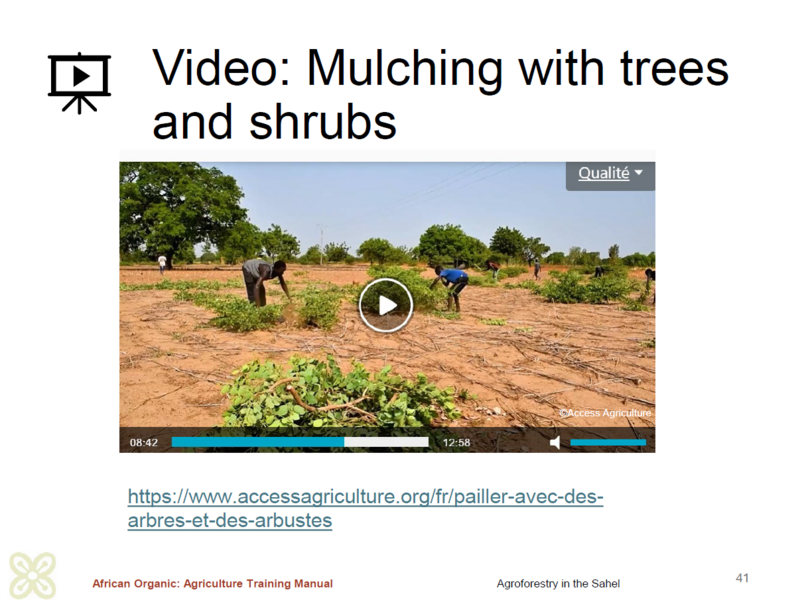
Use this poster and video, produced in collaboration with researchers and farmers, to facilitate discussions with farmers about the benefits of pruning and mulching local shrubs in the Sahel, in combination with sorghum cultivation, in order to increase agricultural yields.
For example:
Have you ever used mulch? If so, what benefits have you observed?
What species of shrubs are available on your land that you could use?
https://zenodo.org/records/17390425
https://www.accessagriculture.org/fr/pailler-avec-des-arbres-et-des-arbustes
Use these posters and the video to start a discussion with farmers about how to apply pruned leaves as mulch to enrich the soil.
 tap and then scroll down to the Add to Home Screen command.