Structural elements of agroforestry systems
In agroforestry systems, there are many different ways of arranging shrubs, trees, livestock and crops. This chapter will introduce some particularly effective and useful structural elements.
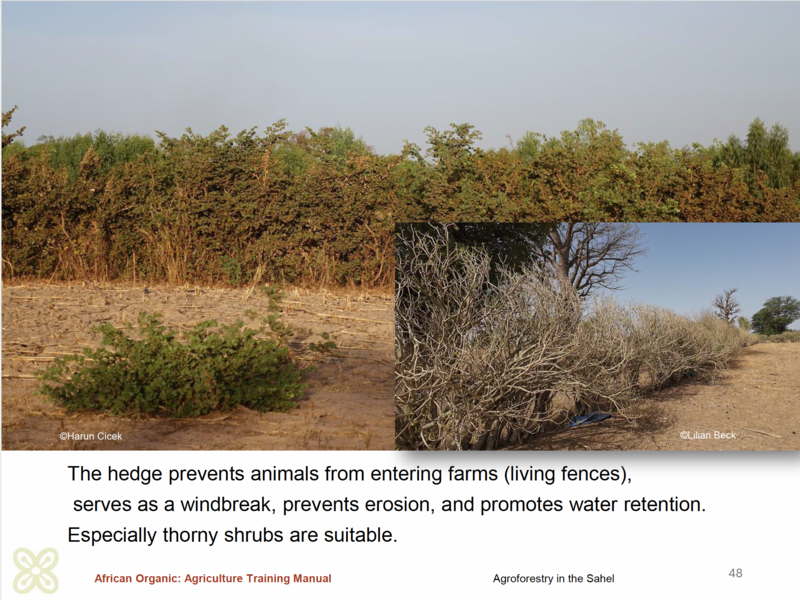
A living fence
A living fence is made up of densely cultivated shrubs or trees surrounding the field. This prevents animals from entering the field and eating the crops. Living fences can be combined with other types of fences, such as mesh fences, to provide stronger protection. The advantage of a living fence is that it cannot easily be removed or climbed over.
It also provides many ecosystem services and ecological benefits for the farm:
Living hedges can act as windbreaks, preventing soil erosion and protecting crops during storms. Trees planted in strips can shield crops, buffer waterways, and provide extra biomass. Finally, the living hedge helps retain water by acting as a barrier to rapid runoff during floods, allowing water to infiltrate.
On sloping land, planting rows along contour lines creates terraces that reduce soil erosion caused by water runoff.
Alley cropping/Corridor cropping
In this system, trees or shrubs are planted in rows, and crops are grown in the alleys between these rows. The ideal orientation is east-west, so that crops benefit from the sun from morning to evening. Spacing depends on the size of the plants: wider for trees, closer together for shrubs that can be pruned . Regular pruning prevents crops from becoming too shaded.
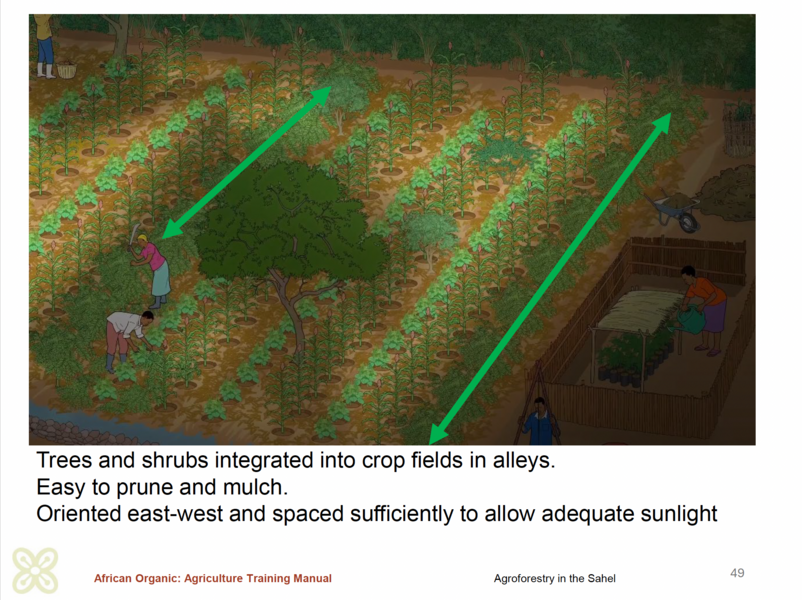
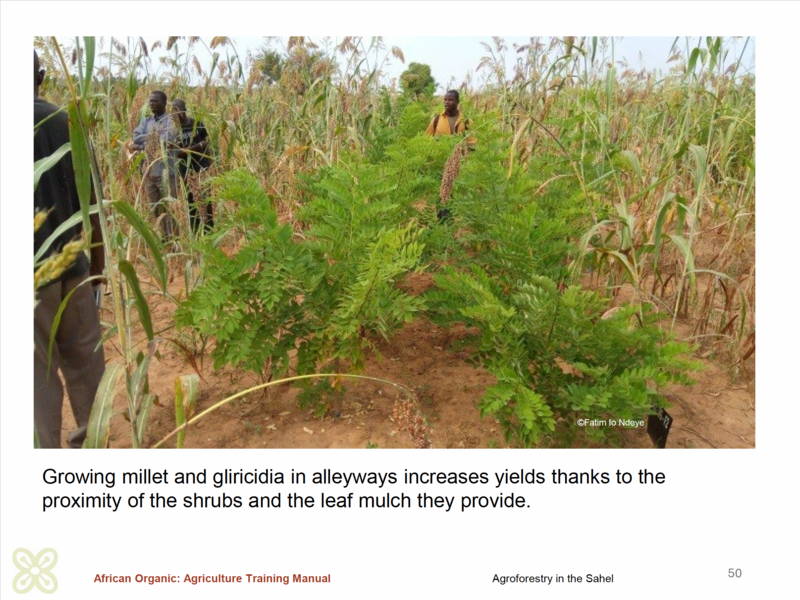
The best suited species for this purpose have an open crown, good regrowth after cutting, leaves that decompose quickly, a taproot system, and minimal lateral root development. Suitable examples include Leucaena leucocephala, Faidherbia albida, jujube (Ziziphus jujuba) or guava (Psidium guajava), and prunable leguminous shrubs such as Gliricidia sepium, Guiera senegalensis, and Piliostigma reticulatum.
This system is particularly suited to the cut-and-carry mulching technique: pruning residues are left directly on the ground between rows, without the need for transport.
This mulching provides organic matter, conserves moisture, limits weeds, and protects against erosion. It also improves soil structure and fertility, nutrient cycling, and optimizes water management thanks to deep roots.
Cultivating microclimatic areas in agroforestry
Another method is to exploit the different microclimates created by the tree. For example, under the canopy of a tree, there is shade, which allows shade-loving species such as taro to be grown. On the other hand, next to the canopy, there is more sunlight, so sun-loving crops such as corn can be planted in these areas.
 tap and then scroll down to the Add to Home Screen command.